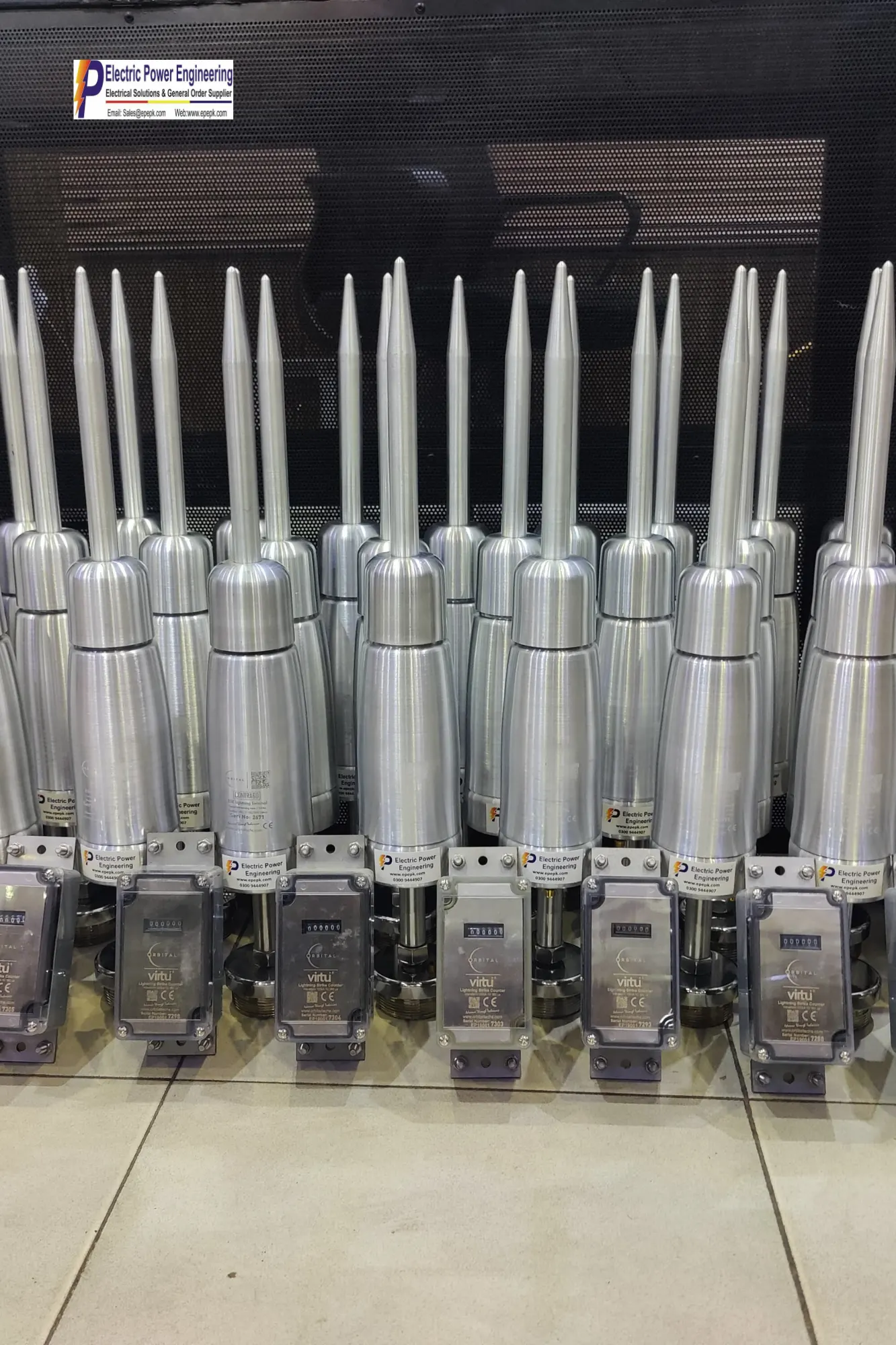
A lightning protection system is an engineered safety network that captures lightning strikes and safely redirects their electrical energy into the earth, preventing damage to buildings, electrical equipment, solar systems, and human life. In Pakistan, where seasonal thunderstorms, monsoon surges, and unstable grid conditions are common, lightning protection is no longer optional. it is essential for long-term safety and asset protection. At Electric Power Engineering, we manufacture and supply advanced lightning protection solutions, including ESE Orbital Lightning Arresters, copper lightning arresters, brass lightning arresters, surge protection devices (SPD), and industrial-grade earthing systems for nationwide projects.
A lightning protection system (LPS) is a complete safety solution designed to protect structures, equipment, and human lives from the destructive effects of lightning strikes.
When lightning strikes, it seeks the shortest and least-resistant path to the ground. A properly designed lightning protection system:
Captures the lightning strike using an air terminal or lightning arrester
Conducts the energy safely through down conductors
Dissipates the energy into the ground using an earthing system
This prevents damage to:
✔ Buildings
✔ Solar panels
✔ Electrical equipment
✔ Data centers
✔ Industrial machinery
✔ Human safety


Different projects require different protection methods. At Electric Power Engineering, we manufacture and supply multiple types of lightning protection solutions.
This traditional method uses a Franklin rod or standard air terminal placed at the highest point of a structure.
Best for:
Small buildings
Warehouses
Low-rise facilities
Limitations:
Limited protection radius
Less efficient for large areas
The ESE Orbital Lightning Arrester is the most advanced and efficient lightning protection technology available today.
ESE stands for Early Streamer Emission. This system actively emits an upward streamer earlier than a conventional rod, capturing lightning from a greater distance.
Larger protection radius
Fewer air terminals needed
Ideal for large industrial areas
Lower installation complexity
High reliability
Applications:
Solar power plants
Oil & gas facilities
Telecom towers
Airports
Data centers
Material quality plays a critical role in lightning protection efficiency.
Copper is the most widely used material for lightning protection due to its excellent conductivity.
Key Benefits:
High corrosion resistance
Excellent electrical conductivity
Long service life
Minimal maintenance
Best for:
Industrial projects
Solar plants
Coastal areas
High-humidity environments
Brass is an alloy of copper and zinc, offering a balance of strength and corrosion resistance.
Key Benefits:
Good mechanical strength
Aesthetic finish
Moderate conductivity
Cost-effective
Best for:
Commercial buildings
Residential towers
Institutional buildings
A lightning protection system consists of air terminals (lightning arresters), down conductors, surge protection devices (SPD), and a grounding or earthing system that safely dissipates lightning energy into the ground.
These are installed at the highest points of a structure to intercept lightning.
Types include:
ESE orbital lightning arresters
Copper lightning rods
Brass lightning rods
These carry lightning current safely from the air terminal to the ground.
Materials used:
Copper strips
GI strips
Aluminum conductors
Lightning doesn’t only strike physically—it also causes voltage surges through power lines.
SPDs protect:
Inverters
PLC systems
Control panels
IT equipment
Communication systems
The earthing system safely dissipates lightning energy into the ground.
Common types:
Chemical earthing
Pipe earthing
Plate earthing
Solar power systems require specialized lightning protection because they are installed at elevated heights and contain sensitive electronic equipment vulnerable to surges and direct strikes.
Panels are installed at high elevations
Inverters are sensitive electronics
DC strings attract surge currents
Downtime causes financial loss
ESE orbital lightning arrester
DC surge protection devices
AC surge protection devices
Proper earthing network
This ensures complete safety of the solar power plant.
Pricing depends on several factors:
Type of lightning arrester
Protection radius
Height of structure
Earthing method
Site conditions
Height of building
Area coverage
Soil resistivity
Type of structure
Electrical load
A professional site survey ensures the correct system selection.
| Component | Price Range (PKR) |
|---|---|
| Copper Lightning Arrester | 3,500 – 8,500 |
| Brass Lightning Arrester | 3,000 – 6,500 |
| ESE Orbital Lightning Arrester | 120,000 – 250,000 |
| Surge Protection Device (SPD) | 5,000 – 45,000 |
| Chemical Earthing Set | 18,000 – 35,000 |

Electric Power Engineering is here to provide top-grade solutions tailored to your project needs.
No.1 manufacturer & supplier in Pakistan.
Copyright © 2025 Electric Power Engineering | Powered by “RS Marketing Experts”

